More than 500 years ago, Machiavelli warned that “there is nothing more difficult to take in hand, more perilous to conduct, or more uncertain in its success, than to take the lead in the introduction of a new order of things.”
He was writing for princes. He could just as easily have been writing for today’s managers.
Change used to arrive on a schedule. Companies planned for it every few years: a new system rollout, a reorganization, a shift in the market. That era is over. Today change is constant. AI is reshaping entire workflows, customer expectations shift quarter to quarter, and competitors appear from directions no one predicted.
Every company is facing change. The ones that struggle are the ones whose managers were never developed to lead through it. That is the real leadership gap in most organizations: plenty of technical and operational skill, and very little change leadership.
Why It Deserves Deliberate Investment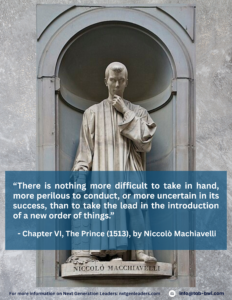
It’s fair to ask why you should build this competency on purpose instead of letting managers figure it out as change arrives. The answer is that learning on the fly is expensive. The cost shows up as stalled initiatives, frustrated teams, and good people heading for the door. Developing the skill deliberately pays off in three ways.
1. You get more from the resources you already have.
Every business eventually reaches a point where growth has to come from working smarter, not from adding headcount. Managers who can lead change find the faster process, the leaner workflow, and the better use of existing tools. Managers who can’t lead change push their teams to work harder inside a system that no longer fits.
2. Better decisions about time and money happen at every level.
Time and money are your least renewable resources, and you owe it to your stakeholders, yourself included, to use both wisely. When managers know how to lead change, that mindset spreads. People throughout the organization start looking for smarter ways to work instead of waiting for direction from the top every time something needs to shift.
3. Your best people don’t burn out.
Companies that treat every change as a crisis to survive tend to run their strongest people and systems into the ground. Teams led by managers with real change leadership skill see change as something to work with, not something to endure.
What Change Leadership Looks Like in Practice
A manager with this competency:
- Explains the why before the what, so the team understands the reason for a change before being asked to adopt it
- Involves people early, drawing on the ideas of those closest to the work instead of announcing decisions after they’re made
- Recognizes resistance and addresses it directly rather than ignoring it or treating it as disloyalty
- Breaks large changes into manageable steps with clear milestones
- Sustains momentum after the launch, when most change efforts quietly fade
Building the Competency
None of this happens by accident. It also doesn’t happen by telling managers to “be more adaptable.” Change leadership is a competency, and like any competency it is built through a proven process, practice, and coaching. Managers also need real ownership of change initiatives, not just a briefing after the decisions are made.
Change isn’t going away. The organizations that handle it best will be the ones investing now in managers who can lead through it, not just manage around it.
Ready to develop managers who lead change? Let’s have a conversation about how our leadership programs can help.